
Why Is Personalization still hard in 2026
Recently I had the pleasure of recording a podcast with Bo Sannung, CCO at Agillic. The conversation covered a wide range of topics – from marketing automation and personalization to AI, data, and decision-making in practice. In this article, I’ve gathered some of the most important points and reflections from our discussion – focusing on why, in 2026, it is still harder than it should be to turn technology into real relevance and business value. Find the Podcast on Youtube or Spotify

Bo Sannung, Agillic
When Automation Creates Relevance – Not Just Reach
One thing is clear in 2026: the possibilities for automating, targeting, and personalizing have never been greater. At the same time, many companies and organizations experience that the impact does not match their level of ambition.
Interestingly, the challenge rarely concerns the technology itself. Marketing automation today works efficiently, reliably, and at scale. The decisive question is therefore not whether we can automate, but how automation contributes to relevance in the relationship between sender and recipient.
When used correctly, automation supports decisions, timing, and coherence. When used incorrectly, it becomes noise. The difference rarely lies in the systems and technology, but in how they are applied.
Personalization as Relationship – Not Just Recognition
Personalization is one of the most frequently used terms in modern marketing – and also one of the most misunderstood. Bo and I agree that personalization is often reduced to recognition: a name in an email, a product based on previous behavior, or repeated messaging across channels.
True personalization is something else in practice. It is about understanding context, intention, and timing. About assessing when communication strengthens the relationship – and when it risks wearing it down.
Context, in particular, is becoming increasingly crucial. Sometimes we are in a professional setting; other times we are driven by personal interests in a private context. Good personalization therefore does not necessarily require more communication, but better prioritization. It requires the courage to deselect messages, adjust intensity, and accept that sometimes the most relevant action is to say less – and choose the right context.
Data as a Driver of Action
Another central takeaway from the conversation concerned data.
Most organizations already have access to large amounts of behavioral data: cross-channel interactions, purchase history, usage patterns, and signals of interest or hesitation. The challenge is rarely a lack of data – it is how the data is used.
In many companies and organizations, data is primarily used for reporting, performance measurement, and evaluation – in other words, historical insights. That creates knowledge, but not necessarily action.
The real value arises when data is used actively to adjust communication in real time, regulate intensity, and support decisions about the next best action. This is where marketing automation moves from being a distribution engine of relevant content to becoming a strategic tool for relationships and business growth.
Marketing Automation as a Living Discipline
Many automation initiatives begin with high ambitions, clear goals, and strong momentum. Over time, however, the impact often flattens out. Not because the idea was wrong, but because automation is treated as something that can be “set up” and then run on its own.
In practice, well-functioning marketing automation requires continuous adjustment, prioritization, and learning. Flows are not static. They must evolve in step with changing behavior, new expectations, and new business objectives – as well as current priorities and key messages that organizations want to present to recipients.
The organizations that succeed best see marketing automation as a discipline that is continuously refined. They work with a few, clear behavioral signals, evaluate impact on an ongoing basis, and adjust communication in small, controlled steps rather than large, infrequent changes.
AI Supports and Elevates Better Decision-Making
AI is – and will remain – crucial, both in terms of competitive positioning and the precision of data-driven marketing automation. However, I question the prediction that AI will take over all automation in the near future.
The greatest value right now arises when AI is used as support and assistance. As a layer that relieves humans in analyzing complex behavior and creating clarity – without removing the human touch and responsibility.
Used in this way, AI can:
Identify patterns and early signals
Highlight deviations before they become business-critical
Support decisions about timing, relevance, and intensity
AI does not become the sender or take control. It becomes the enabler that makes the sender better. Not by replacing judgment, but by strengthening it.
A Simple Model for Using AI with Both Impact and Care
In my conversation with Bo, AI and its application were naturally major topics. For many, AI feels overwhelming – language models, complex calculations, and automation of critical processes.
I work with a model that helps create clarity – especially from the perspective of acting quickly on “low-hanging fruit” while simultaneously innovating the company over the medium and long term. All of it measured against the value creation expected from AI initiatives.
Here is a simple 2x2 model we discussed, which can serve as inspiration and guidance.
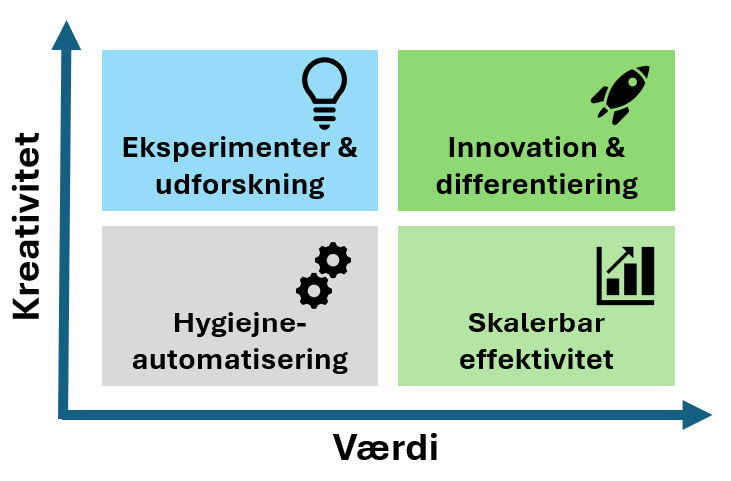
The model balances two dimensions
The X-axis represents the value of initiatives – the measurable, realized business value delivered.
The Y-axis represents creativity – the degree of innovation, concept development, and differentiation required.
Bottom-Left Quadrant: Low Creativity, Low Immediate Value
This is what we might call hygiene automation and minor (though often necessary) improvements. Standard summaries and simple email drafts. Rarely strategic, but useful for training, adoption, and building organizational comfort with AI – and for freeing up time for more innovative work. The key point is that investment and expectations should remain proportionate.
Bottom-Right Quadrant: Low Creativity, High Value
This is scalable efficiency. Examples include automated case routing, quality control, forecasting, churn and risk models, or generative AI in customer service that actually moves KPIs. This is often where the fastest and most robust use cases are found, as problems are well-defined and impact measurable. Many recommend starting here to anchor AI in the business and deliver short-term measurable results.
Top-Left Quadrant: High Creativity, Low Value
This is the experimentation zone. Concept development, mood boards, campaign ideas, “what-if” scenarios, and prototype playgrounds. Extremely valuable for learning and ideation, but requiring clear criteria for when to stop and when to scale – along with defined investment frameworks. Without discipline, AI risks becoming innovation theater rather than an innovation engine.
Top-Right Quadrant: High Creativity, High Value
This is where AI becomes true differentiation. New AI-driven products and services, personalized creative flows, new media and content formats, or co-creation processes where AI and humans work closely together to create both originality and commercial impact. It is the hardest area to succeed in – but also where the strategic potential is greatest.
Here, AI works best as a partner – not a replacement. Human and machine using each other’s strengths.
In the context of this article, the model provides an important perspective: AI is not about automating everything. It is about choosing the right places to apply the technology – with clear awareness of both ambition and expected impact.
More Technology Requires More Humanity
Finally, it is important to emphasize that data, automation, AI, and technology ultimately exist for people. The more we automate, the more important the human layer becomes.
Advanced technology raises the bar for understanding, context, and judgment – not lowers it.
Marketing automation and personalization should therefore not be seen merely as technical matters, but as business and communication choices. Choices about how data and technology are used to create relevance, trust, and long-term relationships.
The question is not whether we can automate more. The question is whether we use automation to create value – for both the business and the recipient.
Conclusion – Relevance Requires Leadership Choices
Based on the above reflections and takeaways from the conversation with Bo Sannung, it becomes clear that the challenge in 2026 is not (just) about access to technology, data, or AI. It is about leadership prioritization, courage, and the ability to translate technical possibilities into coherent decisions that create relevance for customers and measurable value for the business.
Marketing automation, personalization, and AI create real impact when they are integrated into the organization’s decision-making capability. When data is used forward-looking and operationally. When automation is seen as a discipline that is continuously adjusted in line with business objectives. And when AI is used as a “colleague” that enhances quality and speeds up decision-making and execution – rather than removing or taking over responsibility.
Ultimately, it is a strategic choice. A choice about how leadership and organizations use technology to strengthen relationships, improve timing, and create coherence across the organization.
The more technical possibilities we gain, the greater the demand for judgment, contextual understanding, and the ability to prioritize – not just technically, but strategically.
This is precisely where we at NexusOne operate. We help companies translate data, CRM, marketing automation, and AI into concrete, value-creating solutions that work in practice and can be measured by impact. Not as isolated technology projects, but as end-to-end solutions fully aligned with the company’s strategy, vision, and objectives.
If you’re curious about how this can be approached in practice, feel free to reach out.